

Russell & Celtics622 words
Number 6, retired league-wide
Three different things get called “retiring a number”, and only one of them happened across all thirty teams. The difference is why players already wearing 6 did not have to change.
What is in this piece — 5 sections
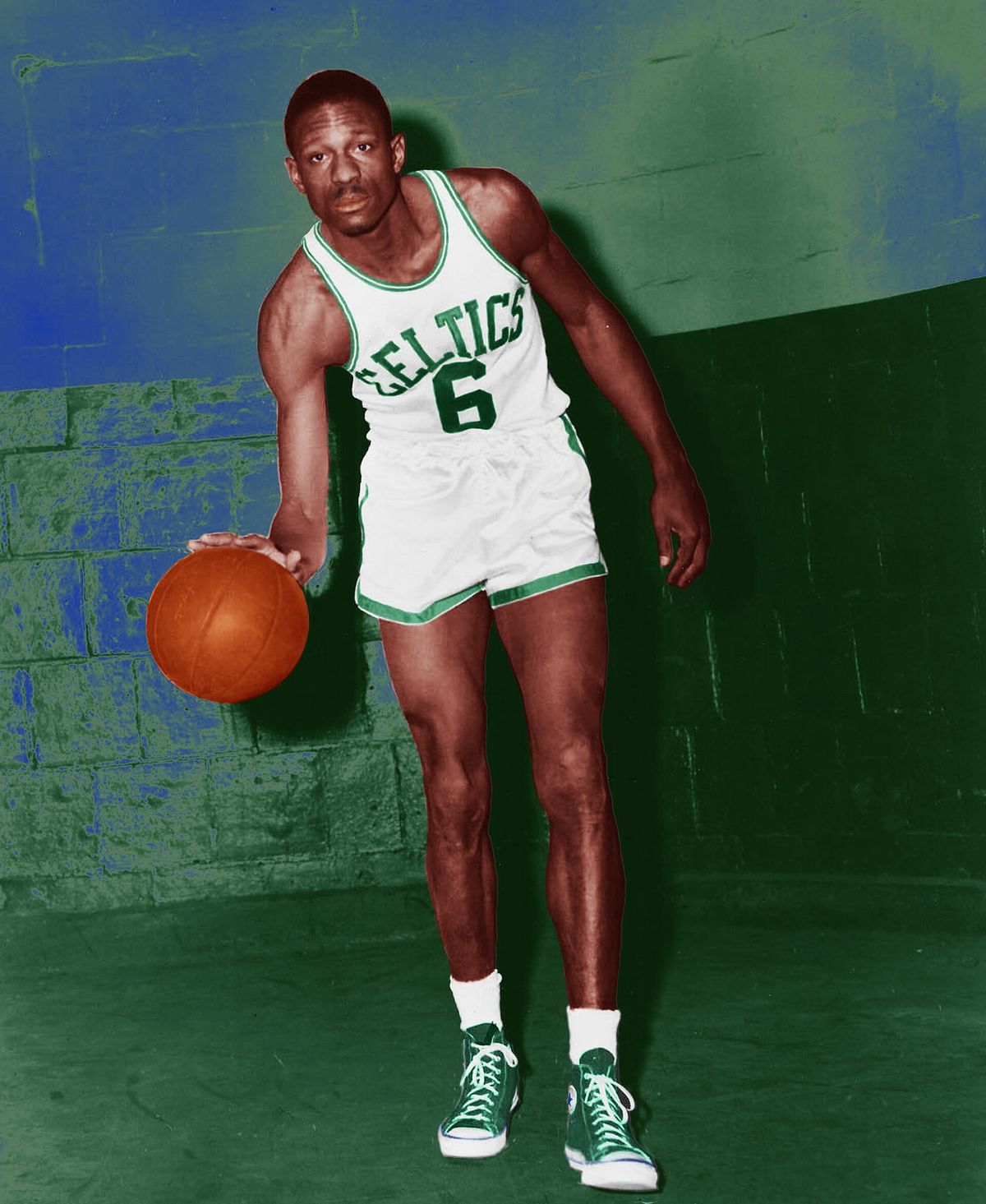
On 11 August 2022, eleven days after Bill Russell died at 88, the NBA announced that number 6 would be retired across the entire league. He became the first player in the league's history to be honoured that way. The sentence is simple; the mechanics behind it are where readers get lost, because three separate things are routinely described with the same four words.
Three kinds of retirement
A team retirement takes a number out of circulation for one franchise. The Celtics did this for Russell in the early 1970s: his 6 went to the rafters of the Boston Garden and no Celtic has worn it since. Thirty teams can each do this independently, which is why the same number can hang in several buildings for several different players.
A league-wide retirement takes the number out of circulation everywhere. Before August 2022 the NBA had never done it. After it, no team may issue number 6 to a new player.
Grandfathering is the part that confuses people. Players who were already wearing 6 when the announcement was made were permitted to keep it — LeBron James among them. Nothing was taken away from anyone; the number simply stopped being available to anyone new. A reader who sees a 6 on the floor after 2022 has not caught the league breaking its own rule. They have caught the rule working exactly as written.
What the league added to the floor and the jersey
Two visible markers came with the decision. Every player wore a commemorative patch on the right shoulder of the jersey, and every court in the league carries a clover-shaped logo with the number 6 on the sideline near the scorer's table. The clover is a Boston reference on twenty-nine floors that are not Boston's — which is, in its own quiet way, the whole point of a league-wide honour.
Why the distinction is worth getting right
It is not pedantry. The three mechanisms have different owners, and that determines who can undo them. A team retirement is the team's own decision and teams have un-retired numbers before, usually at the honoured player's request. A league-wide retirement is a league decision and sits above any one franchise. Grandfathering is a transitional rule attached to the league decision, not a loophole, and it expires on its own as the players holding the number finish their careers.
The same care applies to the phrase “his number hangs in the rafters”. In Boston that is literally true and has been for half a century. Across the league it is a different instrument with a different history, and the two were four months apart from being fifty years apart.
How to check a claim about a retired number
- Ask whose decision it was. League announcements are published by the league's own communications office; team honours are announced by the team. If a claim cannot be traced to either, treat it as a story about a story.
- Ask what the announcement actually forbids. “May not be issued” and “may not be worn” are different sentences, and the 2022 announcement used the first one.
- Ask about existing holders. A rule that changes the future and leaves the present alone is the normal shape of this kind of decision, not an inconsistency.
The project's own pages set out what the eleven championships and the number stood for in Boston: the project's account of his career, and the City Hall Plaza memorial, whose eleven granite elements carry the same count. The photographic record is in the project's photo file; the rest of this desk is on Russell & Celtics, and the full index is in the archive.
What we read
Every figure above comes from one of these documents. If a number is not in them, it is not in this piece.